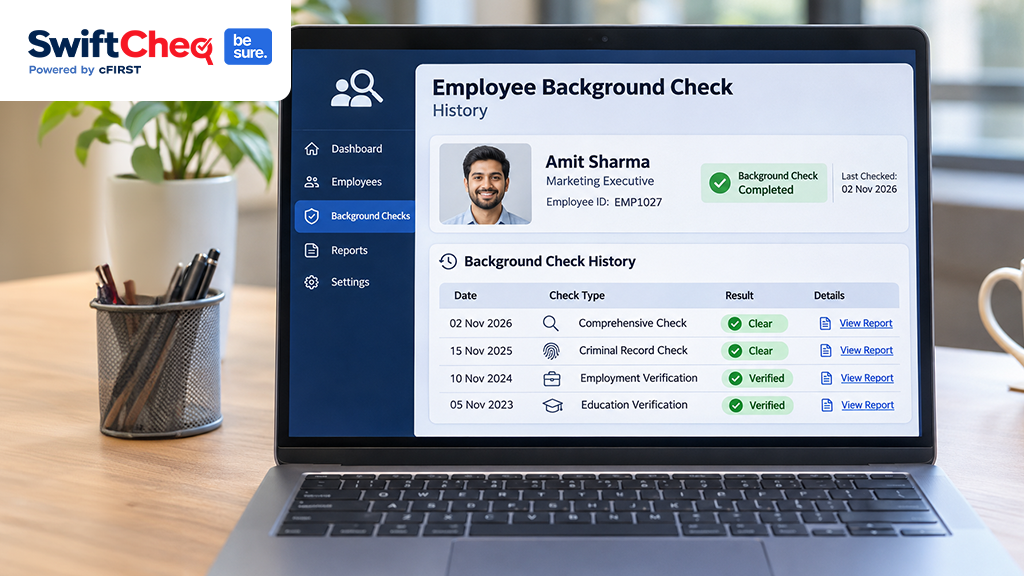

Hiring fraud is a real risk in India; companies rely on digital documents and remote interviews for recruitment. According to a report, in the first half of fiscal year 2026, 4.33% of white-collar background verification cases reported discrepancies, and 2.5% of gig-worker checks failed. For small and MSME companies with 20 employees, one fraudulent hire can have a disproportionate impact on a small team. That is why reliable identity verification is important. SwiftCheq assists MSME businesses with employee background check services in India.
Identity verification is one component of employee background verification. Employers should also check relevant employment history, addresses, and educational qualifications, depending on the role.
| Stat | Figure |
|---|---|
| White-collar identity check issues (H1 FY26) | 1.17% |
| Gig-worker identity (NID) failures | About 2.5% |
| All white-collar discrepancies (H1 FY26) | 4.33% |
| Employment check discrepancies (white-collar) | 11.15% (adjusted: 7.68%) |
Note: Discrepancies do not necessarily indicate confirmed fraud.
An applicant may submit an altered identity document, such as an ID card with a modified photograph or other details. Employers should verify document authenticity rather than relying solely on a photocopy.
A candidate may use another person’s identity documents, creating verification risks in gig work and field-based roles. Employee identity verification helps small businesses confirm that the documents and records belong to the person being hired.
Another individual participates in an interview or online assessment. Infosys postponed hiring assessments in June 2026, affecting over 20,000 applicants, following reports of impersonation and assessment malpractice.
With technology and AI, many candidates may misrepresent who is attending a remote interview using AI-generated or manipulated video.
Without a dedicated HR or verification team, small businesses often hire in batches. For a small number of hires at once, traditional verification arrangements might be challenging to manage. Additionally, manual document checks and remote interviews leave gaps.
The impact can be especially large for a company with 20 employees. Financial losses, unauthorized access to private information, operational disruption, and additional recruitment expenses can all result from a single fraudulent hire. Identity verification can also assist companies in managing access and accountability risks in customer-facing, financial, logistics, and field-based roles.
A practical solution should fit within HR’s constrained bandwidth, avoid needless minimum-order commitments, and yield clear results. Small teams can consistently verify candidates without adding undue administrative work by using a structured background verification process. Businesses can make better hiring decisions while concentrating on daily operations by streamlining identity checks, candidate document collection, and consent management with the use of a background verification for small businesses, SwiftCheq.
First, obtain and record the candidate’s consent. Explain the checks you will carry out, why the information is required, and how it will be managed.
There are many cases of companies just photocopying the Aadhaar details rather than checking it. The UIDAI provides an official QR code scanner. Its digitally signed QR data verifies document authenticity and detects tampering. Before proceeding with offline verification, use an authorized scanner and obtain consent.
There is a rise in cases where someone else is giving an interview for the candidate. When conducting remote interviews, keep the camera on, and during the joining procedures, make sure the person attending has their identification.
Inconsistencies should be investigated rather than assumed to be evidence of fraud. Verify the candidate’s address and employment history, including UAN-linked employment details if available and authorized.
SwiftCheq can help you manage consent, document uploads, and identity checks. Our background verification platform provides identity checks for PAN, Aadhaar, and government-issued IDs, as well as a link for document submission and consent from candidates.
Businesses should confirm the provisions and rules in effect at the time of implementation. Follow relevant UIDAI regulations for Aadhaar collection, storage, and redaction; do not presume that a photocopy can be kept unrestricted.
Employers should follow applicable UIDAI requirements when collecting or verifying Aadhaar information. For offline verification, organisations must follow the relevant consent, purpose-disclosure and data-handling requirements. They should also review applicable restrictions on collecting, using and storing Aadhaar numbers. A photocopy should not automatically be treated as permission to retain Aadhaar data indefinitely.
The Digital Personal Data Protection Act, 2023, establishes a framework for processing digital personal data. Employers should review the applicable provisions, rules, and commencement dates when establishing their verification procedures.
Before publishing or depending on these claims, make sure you understand the relevant terms and privacy policy.
| Factor | DIY Checks | BGV Platform |
|---|---|---|
| Time per hire | Chasing documents by hand | Candidate uploads; you track status |
| What it catches | Obvious mismatches | Forged IDs, history that doesn't match |
| Consent records | Self-managed | Captured per candidate |
| Audit trail | Scattered files | Signed report |
| Cost model | Staff time | Pay per check, no minimums |
SwiftCheq provides digital background verification for startups and small businesses through a self-service platform designed to simplify candidate checks.
Candidate consent | Flexible pay-per-check model | cFIRST-powered verification
Yes. Use the official Aadhaar QR Code Scanner from UIDAI. This is not a replacement for all forms of identity or background checks; rather, it is a document-authenticity check.
Aadhaar offline verification requires informed consent. Before processing personal data, comply with applicable laws, give pertinent privacy information, and establish a legitimate basis for any additional background checks.
Depending on the goal and jurisdiction, police verification is typically a police-led identity, address, or history check. A background check covers identity, employment, education, and relevant court records, etc.
It depends on the check, the source availability, document quality, and the candidate's response time.
Examine the disparity and request clarification or supporting documentation from the candidate. SwiftCheq's "Need info" flag may show that more details are needed. Rejecting a candidate based only on an inexplicable mismatch is not appropriate.
Even with a small HR team, incorporate identity verification into your hiring process.